Wednesday, December 12, 2012

Putting the Hip in Church Planting Fellowships : The Law of Unintended Consequences

     The other day, my wife (who happens to be one of the most hospitable and generous people I know) made a meal for some good friends of ours who had just welcomed their third child into the world. Now, my wife does an excellent job on two fronts with these meals: 1) She stays on top of caring for others with them; and, 2) She does a very good job of figuring out what kind of meal should be made and then does a great job making it. So, last week, to accompany some well-made soup, she found a recipe for bread that we hadn't tried before, a recipe that had received some good reviews from others. The soup turned out well. The "bread" did not. Accordingly, it did not accompany the soup to this family, whom we care about and did not want to be responsible for breaking any of their teeth. As an aside, if anyone works for a brick manufacturer and would like to find a way to only heat their bricks in a 300+ degree oven (as opposed to the kilns presently used), we have a bread recipe that would substitute your brick recipe well.

     Last week, I began a series entitled "Putting the Hip in Church Planting Fellowships," providing some perspective on what I see as some missteps in contemporary philosophies of church planting. Let me emphasize again that I love church planting as a ministry, which is one reason I hope these posts will resonate with folks. Because I want to see church planting increase and be done the right way. But not only one or the other. They both have to be there. And that leads us into today's post.

     Like the recipe my wife used to make the brick-bread, a philosophy of ministry that fails to incorporate the necessary components will inevitably fail. For whatever reason, the results might be endorsed by a whole host of people. And it might even seem to start out well, like a good recipe would have it. But neither endorsements nor good beginnings avail for a good loaf of bread or, much more importantly, a healthy local church. So my concern here in these posts is to address a missing step in the recipe for planting local churches that, in my opinion, is creating a local church culture in the United States that is out of character for that most precious ministry. It is the "law of unintended consequences" - well-intended tweaks to the nature of a ministry that ends up rerouting things down the road in ways not intended, yet damaging to churches, families, individuals, and the culture at large.

     This post is intended to give you a preview of some of those concerns, which I'll pick up and discuss over the days ahead. Each concern has its place and will have a separate post devoted to it. The list below summarizes the inevitable "unintended consequences" that, in my opinion, the present emphasis in the church planting culture on targeting segments of culture rather than geographic regions are creating, both short-term and long-term:

  • A divergence from the biblical pattern of gospel-centered identity inevitably promoting a culture-centered identity among those gathered in the church plant;
  • Focus on a segment of culture inevitably gathers a homogeneous group. Accordingly, this group fails to represent the cross-cultural character of the New Testament church that testifies to the supremacy of the gospel. Along with this, the group will find it difficult to pursue the missionary enterprise of the church in pursuit of others, both "naturally" and due to the reinforced philosophy that focuses on people "like them";
  • The oft-selected subcultures tend to be widely shared in church planting fellowships. Twenty years ago, it was "unchurched Harry and Mary." Now it appears to be hipster Harry and Harriet or tattooed Tom and Tracy. But this emphasis on targeting subcultures ends up marginalizing such a tremendous percentage of the population that instead of evangelizing a community, it evangelizes a part of the community. And the rest of the community continues to go unreached, though the statistic of a "church plant" goes up, gets us excited, and leaves thousands of people without a witness while zeroing in on a few hundred.
  • When emerging or popular subcultures are targeted, an inevitable premium of the church plant ends up being "newness" or "relevance." While this dynamic may "help" some folks who spend Sunday mornings in a bar, it can be a major stumbling block for the large percentage of folks who spend Sunday mornings at churches that proclaim a false gospel. When these people encounter someone from Hipster Church of Cooltown, they stumble over the apparent lack of transcendence accompanying worship and would prefer to stay with something familiar that at least "seems" like a real church. While there's nothing necessarily wrong with being from Hipster Church, why is it okay to justify the "relevance" as the removal of a stumbling block, when a large percentage of Americans are more prone to stumble over the fact that a church plant doesn't even seem like church to them?;
  • When we target subcultures, we inevitable shift the focus off of the transforming power of the gospel and the saving power of the Triune God to a subtle trust that our methods are trustworthy enough to hang the church's hat of identity on. "We're not like other churches" shouldn't be the banner flying over a church unless it's because every other church in the community fails to proclaim the glorious gospel of God's grace to sinners through Christ;
  • Instead of reconciling natural differences by the gospel and providing occasion for actual application of that amazingly peculiar effect of the gospel within the body of Christ, it can further harden long-held differences that are based on culture, rather than believer/unbeliever. In a culture that continues to demonstrate racism and class warfare as not only de facto, but even pursued for the sake of political gain, there is tremendous opportunity for church plants that embrace a model of ministry holding forth the gospel as a reconciler of man to God, first, and then men to men as a byproduct of great witnessing value;
  • Prioritization means time and resources that are diverted from elsewhere. Which means that even the best-intentioned efforts to plant culturally-targeted local churches end up focusing more on sharpening cultural relevance than they should, while diverting resources away from the biblically emphasized ingredients for a healthy local church;
  • And, finally, what happens when the targeted culture becomes over-saturated? Not only do we end up neglecting a large segment of the population, but we end up burning over a segment that will, over time, inevitably "die out." Focusing on the hipster crowd today will only last as long as there is a hipster crowd to focus on. The crowd either changes, dies off socially, or dies with the people who comprise it. The church then becomes irrelevant, unless it grows with the group it targeted, which, in my mind, inevitably means that they move closer to what should have been done in the first place: focus on the under-evangelized community as a whole instead of a small fragment of it.
     I hope these thoughts provide some more thought stirring-up in your mind. As I seek to address the concerns individually and expand on the problem and seek to show how a different philosophy of church planting can help avoid the "unintended consequence," I genuinely desire this to be a sharpening and edifying series. Stay tuned.

Saturday, December 8, 2012

Book Review : The Acts of the Risen Lord Jesus (NSBT) : Alan Thompson

Two things to kick off this book review that I want to grab your attention right away :
  • It's my opinion that the book of Acts is arguably one of the least understood books in the New Testament. The misapplication of this valuable portion of sacred Scripture is, sadly, behind the development of some very unhealthy theology. Accordingly, getting the book "right" is absolutely critical for those responsible for handling the Word and leading in the local church.
  • Before I even get to the review itself, I have to say that Alan Thompson's entry into the New Studies in Biblical Theology series, The Acts of the Risen Lord Jesus (being reviewed here), is an extremely valuable read. It's a five star book and I hope that can encourage you to consider this book as a study aid in approaching the book of Acts.
That being said, here's the official "review":

     Over the past decade plus, InterVarsity Press has been releasing some excellent volumes in a series entitled "New Studies in Biblical Theology." With contributions from scholars such as David Peterson, Greg Beale, and Andreas Kostenberger, the NSBT series, which is edited by D.A. Carson, is a treasure chest of biblical theological insights that are academically rigorous and evangelically faithful. There is a lot of very helpful material to be found in these books (at least in the few I've looked at).

     How does Alan Thompson's entry, The Acts of the Risen Lord Jesus, which concerns a biblical theological framework for approaching the book of Acts, stack up to that reputation? With all of the out-of-the-strike-zone stuff out there regarding a theology of Acts, what kind of material does Thompson supply to the discussion? And with all of the differing interpretations of Acts, what really qualifies as a convincingly biblical theology of Acts? In light of all that background, I'm very happy to say that I found this book to be incredibly helpful. Frankly, I haven't read a more paradigm solidifying synthesis of theological analysis pertaining to a scriptural book/author in recent memory. It really is that well written and thoroughly biblical

     After introducing the book, Dr. Thompson supplies an initial framework for approaching New Testament theology, generally referred to as the "already/not-yet" description of the Kingdom of God. (If you're not familiar with that hermeneutic, check out Graeme Goldsworthy or George Eldon Ladd, who supplied some contemporary pioneer material on the Kingdom come/yet-to-come theology.) From that starting point, he treats the place of Jesus' death and resurrection in Luke's theology, with particular emphasis on how the resurrection is emphasized in Luke and Acts. Continuing, Dr. Thompson addresses what I think is one of the most critical areas of interpretation that fails to be understood in many deficient approaches to Acts: the missionary character of the book, particularly the expansion of God's Kingdom beyond ethnic Israel to include Gentiles throughout the earth. Chapter Four concerns the role of the Holy Spirit, which treatment by Dr. Thompson is excellent in its correction of the unhealthy doctrine of the Spirit held in many circles of popular evangelicalism today. Chapters Six and Seven address the role of two very significant factors in Old Covenant Judaism and the place that it takes in the life of the New Covenant community, as communicated by Luke. The final Chapter is a conclusion of the material.

     All things considered, while the book may be a bit more "technical" than some folks are used to, I would recommend that any Christian with an interest in understanding a biblical framework of Acts ought to pick this book up. Simply put, this book is well-written and thoroughly biblical. Thanks to the folks at InterVarsity Press for providing me a no-cost copy of this book for review purposes. While there was no expectation of a positive review on their part, I am glad to have had the opportunity to read through this excellent volume in the NSBT series.

Tuesday, December 4, 2012

Putting the "Hip" in Church Planting Fellowships . . .

I'm Not Cool . . . and That's Getting to Be More and More Okay

     About ten years ago, I had the honor of serving for two years with Campus Crusade for Christ. (Yes, for the most part, I still refer to it as Crusade.) One of the tremendous blessings of serving with Crusade for that time period was working with some other Christians whom I still think of fondly. I remember there was a song that my good friend Seth and I latched on to for a little while by a guy named Scott Krippayne. The title, "I'm Not Cool," pretty much conveys the gist of the song. Scott Krippayne had come to the realization that a lack of coolness didn't ultimately undermine God's love for him. (If you want to check it out, I put a link to the song on YouTube at the end of this post.)

     The song gets across a pretty fundamental reality that should be held close to the heart of every Christian, not only because it's comforting to those of us who would rather go to a historical sight than Six Flags, but because it's biblical. And if that doesn't run like rebar through our lives as Christians, we better double-check what is, right? Being cool, hip, good looking - none of these things are commended to the church of Jesus Christ as being a focal point of our identity. If anything, we're given some pretty clear ideas that God delights to use those who aren't in those categories for the very purpose of showing how great He is through those whom the world at large would write off as unimportant, obscure, and undesirable. It's a hard thing keep in view when sin is in the business of self-promotion, but it's necessary. Which brings me to what this post is about - and what I'll be writing about over the next number of days in the hope that it resonates with some folks and provides perspective on what I believe is a subtle, yet pervasive issue affecting church planting fellowships in the United States.

Putting the "Hip" in Church Planting Fellowships

     I really need to kick this off by stating something with crystal clarity: I am thrilled at the resurgence of church planting as a focus among denominational and para-local church organizations. It's a blessing and I rejoice that there are more and more who are heeding a call to serve the cause of Christ by proclaiming the gospel to communities devoid of significant and faithful gospel witness. I have friends who have left and are leaving the "security" of other positions to pursue church planting in the very contexts that I'll be talking about here. Further, what I'm going to be discussing over the next handful of days isn't something that should be discarded as worthless or unworthy of pursuit. Let me write, in bold letters, that my desire is that we would become aware that an over-emphasis on a particular "kind" of person or subculture can have unwanted consequences that we would do well to check ourselves on. That's my disclaimer. So don't get hot under the collar because of stodgy old Chris. I hope that's clear at the outset and should be clear throughout the posts on this issue. Good deal? Alright.

     The posts to come will talk about specific aspects of the concern I'm voicing here, but today I'm giving the birds' eye view. It's been alluded to already in the bolded words above, but what my intent is over these posts concerns a pattern I've become concerned about lately for a few significant reasons. Essentially, what I've become troubled by is the increasing tendency among church planting fellowships over the past twenty-five years to focus church planting efforts on what are seen as majority or emerging subcultures. The efforts are put forth to send out a church planter who is passionate about - or identifies with - a particular subculture, in the hopes that the shared affinity, concerns, likes, appearance, clothes, you name it, will serve as a magnet to draw people into the new church. Take a guy who has a heart for evangelism and also happens to really like fishing and drop him off in Tomahawk, Wisconsin. That's a really boiled down, over-simplified idea of the approach.

     So what's wrong with it? Well, frankly, nothing - inherently. There isn't anything necessarily wrong with a church planter liking the same music or sports team as the folks he's seeking to reach. It can be an asset. However, the inherent non-issue can become a real issue fast. And the fact that is an issue can stay well under the radar screen until some damage has been done. So as we move into looking at this trend in church planting - particularly the unintended "side-effects," I want to pose a few questions to stir some thought related to why this inherently benign approach can quickly undercut some very important priorities of New Testament ministry:

  • How does this square with Paul's missionary heart that reveals a design to maintain a gospel-centered focus and still work to serve "all people" in the proclamation of the gospel?
  • Who decides what communities/subcultures are more or less in need of church planting? Should Anytown, which has 30,000 residents (20% of which are considered "aging") and an employment environment of low-mid income manufacturing and only two decent churches, be deprived of a gospel-centered church in favor of Cooltown, which has 50,000 residents, twenty decent churches, and a large percentage of unchurched baby boomers and tech professionals?
  • When targeting subcultures, what can inevitably become the missional focus - the people in the subculture or proclaiming the gospel to the community as a whole?
  • What happens to the non-targeted subcultures? Honestly speaking, are there many church planting initiatives seeking to incorporate the elderly? The "religious yet unsaved"? The home-bodies? The guys working shift jobs?
  • When riding cultural trends, is there a danger of losing connection with the larger history of the church throughout the world?
  • And finally, When church planting takes on this approach as an identity, is there a real danger to rely (inappropriately) more on these cultural affinities than on the power of the Holy Spirit to bring dead sinners to life and put their trust in the gospel of Jesus Christ?
     These questions are important. And again, they're not meant to lop off anyone's legs. But they are there to provoke some thought about why we do what we do and how we do it. By way of extension, most of these questions are equally applicable to existing local churches and the way we approach our "philosophy of ministry" in our relationship to ministry and culture. Over the next number of days, I want to draw out what I believe are some unintended, yet major consequences that attend an over-identifying our philosophy of ministry with the targeting of sub-cultures small and large. I do hope that this can be truly edifying and perhaps stir up some of us not to avoid church planting as a ministry, but to pursue church planting with even greater vigor and dependence on the Lord Jesus Christ.

As promised, here's the song "I'm Not Cool" by Scott Krippayne:

(I appreciate the reference to the bizarre nature of the El Camino.)


Friday, November 23, 2012

Book Review : Dangerous Calling : Paul David Tripp

One of the things I appreciate about having a library card is that I can go online and find repair manuals for cars, look at them for free, and save a chunk of money on a) taking a car to the mechanic and b) showing up at AutoZone and buying one. It's a nice perk of the whole public library system, because while I may be eminently unqualified to open my own repair shop, the fact that others know what they're doing gives me some confidence to not consign all of my car repair needs to a "professional." Because frankly, at the end of the day, some of these repairs just aren't that difficult if you follow the manual. You just have to trust that someone actually knows the vehicle enough to tell you what to do.

Paul Tripp writes repair manuals for people. Solidly grounded in Scripture, the man has written some profoundly helpful materials that combine wisdom gained over the years, a readable style, helpful examples, and well-applied exposition of the Word of God. I have yet to find something of his that is not worth consulting concerning the issue it addresses and would unhesitatingly recommend that any Christian pick up a copy of one of his books to work into a better understanding of their own heart and the precious and sometimes painful process of growing in godliness.

I was excited, then, when I saw that Dr. Tripp was releasing a book geared especially towards the issues that face men called to serve in pastoral ministry. And the title of the book hits the sweet spot for communicating the core reality that serving as a shepherd of God's people is not simply about "showing up." Dangerous Calling: Confronting the Unique Challenges of Pastoral Ministry is a book that begins to tackle some otherwise sorely unaddressed issues facing pastors (both vocational and "lay" elders, more on that in a bit). Some of the chapter titles include "Big Theological Brains and Heart Disease," "More than Knowledge and Skill," "The Missing Community," "Mediocrity," and "Self-Glory." Those are just some of the titles that give a hint about what's behind the door, while the other chapters get just as involved in addressing issues that pastors face, but are rarely warned of.

In essence, Dangerous Calling is the literary equivalent of a short-term mentoring relationship with a man who has faced these issues personally and seen them unfold as a counselor to both individual pastors and local churches dealing with them. Thinking back on reading through the book, I can almost picture Dr. Tripp sitting down across from me and talking through some of the most perilous issues pastors face with a good dose of personal care and an equal dose of "don't mess this up."

While addressed to pastors - and it really should be, so far as "contemporary" books are concerned, on the syllabus for any pastoral ministry course offered in seminary - the book is also aimed at elders (who are truly pastors of the local church, even if they're not paid for the service rendered), the wives of pastors, and pastoral search committees. For that matter, it would be decent reading for any Christian to understand the unique challenges facing pastors and, perhaps most importantly, what kind of expectations are fair in their relationship to the men called to serve as soul-shepherds.

My goal here is not to go into all the content found in the book because the vast majority of it is both necessary and well-stated. But I want to highlight a major purpose of the book that, in my eyes, should be held in view as a primary purpose of why reading this book should be on the assignment list for folks in the above-mentioned groups for the coming year. That purpose is to provide a biblical and realistic context for understanding the pressures, temptations, and fragility relating to men serving in the office of elder. Because in the final analysis, we all (pastors and non-pastors alike) bring some pretty strange assumptions to the table regarding what it means to keep watch over the precious entity called the local church. With an increasingly bizarre and counter-biblical character, the "evangelical" sub-culture simply doesn't provide a consistent display of pastoral service. And the very real experience of many professing Christians jumping from one church to another with near-regularity, it's just (with great sadness) not realistic anymore to expect deep relationships to exist between shepherds and sheep. Which makes it horribly difficult to expect that a sound regard for the pastor's role and responsibilities should be found among the majority of the folks pastoring and being pastored. It's sad, it's unfortunate, it's scary, but it's a reality that exists in the 21st century American church. And that makes Dr. Tripp's book a healthy dose of medicine to start treating an illness that is literally robbing the local church of health at the pace of an epidemic.

There is great content to be found here, from treating the pastor in his temptation to seek a small empire to the much neglected need for the pastor to see himself as another part of the body that functions by the same grace and according to the empowerment of the same Spirit that all other Christians do. The book is well-worth the time and money to pick up and read and highlight and share. Elders should discuss it together, wives should nab it off the bookshelf, and pastoral search committees should read it together before coming up with a job description and application. This is certainly one of the best books I've read on the heart of pastoral ministry and I highly recommend it. Thanks to the folks at Crossway for providing me a complimentary review copy, with no expectation of a positive review.

Friday, November 9, 2012

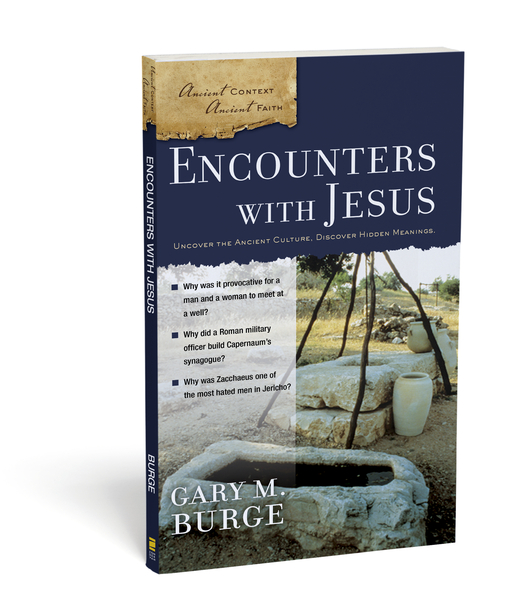
Book Review : Encounters with Jesus (Ancient Context, Ancient Faith) : Gary Burge

A prevalent term for conversion in the contemporary church (at least at the turn of the century) is someone "coming to know Jesus personally." When someone turns from their sin and puts their trust in the Lord Jesus Christ for their righteousness, that person truly does come to know God in a personal way, as one claimed in the New Covenant and the indwelling, personal presence of the Holy Spirit. The Christian is someone who has come to know the God whom we had been at enmity with and come to know Him by His sovereign grace. So "knowing God" describes a change in relationship between the Christian and the Triune God. But a change in relationship sets the table for what follows in coming to know who God is, what He is like, and what He has done. Which is why we are greatly helped in applying ourselves to the great tasks of learning Scripture and learning about Scripture as it reveals to us the work and character of our great God.

Gary Burge's third entry in his series "Ancient Context, Ancient Faith" is entitled Encounters with Jesus and, like the previous two, the title doesn't veer much from accurately summing the book's content. Like the other two volumes, Encounters with Jesus is written in order to provide a better sense of the richness of Scripture by developing the context surrounding different passages or themes. And because reading about the Savior can help us, by grace, come to know Him better, this book can be particularly helpful for those looking for a more devotionally-applicable book supplying context to our understanding of Scripture.

The book is divided up into six chapters, the first of which is essentially an introduction. The first chapter opens by asking "Have you ever wondered what it would be like to encounter Jesus personally?" That question sets the tone well for and provides ample justification for remaining interested in this book that is uniquely devoted to developing the cultural context of five "major" encounters between individuals and the Savior recorded in the Gospel accounts.

The five encounters opened up by Dr. Burge in this volume involve:
  • The woman with a chronic hemorrhage (as recorded in Matt. 9:18-26 & Mark 5:21-43)
  • Zacchaeus the tax collector (as recorded in Luke 19:1-10)
  • The Capernaum centurion (as recorded in Luke 7:1-10)
  • The Samaritan woman at the well (as recorded in John 4:4-26)
  • The Greek woman at Tyre (as recorded in Matt. 15:21-28 & Mark 7:24-30)
Dr. Burge, as a New Testament scholar, provides trustworthy background on these encounters while remaining accessible to Christians with little academic/theological background. The presence of pictures on so many pages gives a good visual sense to the reader, while Burge's language is engaging and keeps the chapters flowing well.

Altogether, this book sits right alongside the other two entries in the series offered by Dr. Burge previously (The Bible and the Land and Jesus, the Middle Eastern Storyteller) in this series. This book does a serviceable job in providing a better and accessible understanding of the cultural relationships that set the background for the grace and mercy of the Lord Jesus poured out in the lives of certain individuals recorded in the Gospels. Hopefully that understanding pushes the reader to draw with greater expectancy to the throne of grace. Thanks to the folks at Zondervan for supplying me with a complimentary copy, without any expectation of a positive review.